[VISIT US HERE OFTEN - FILMS ARE BEING ADDED
ON A REGULAR BASIS]
NOW
AVAILABLE ON DVD!
(Click the image below for more information:)
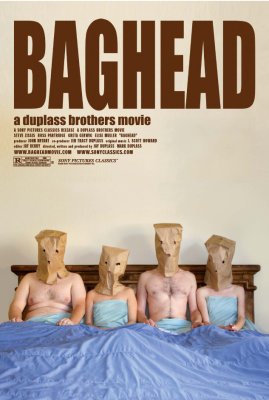
"BAGHEAD"
Budget: Low Enough
The Duplass Brothers returned to Sundance in 2008 with a film that
became somewhat of a sensation, getting picked up for distribution by Sony Pictures Classics at the festival. I saw it in
a packed press screening and critic-types were buzzing about it out in the hall afterwards. What was all the buzz about?
Well, the Duplasses have done something new here and they've done it very well. They've taken their trademark off-the-cuff,
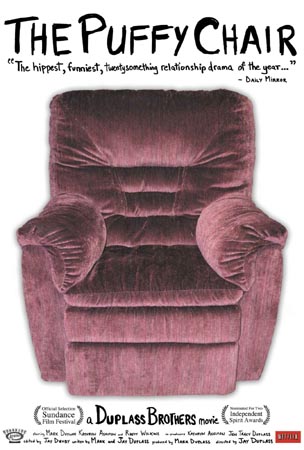
naturalistic style of filmmaking, first seen in a number of successful shorts and then in their first feature "Puffy Chair," and applied it to a genre film. I don't want to give too much away here, but it was clear to me as I was watching it just
how unique this was and just how hard it was to do it well. They have in effect expanded on the "mumblecore" technique, and
broadened the appeal of their style without losing all the things that made that style great in the first place.
Most people look at films like these--improvisational dialogue, handheld camerawork--and think it must be easy. Sure, it's
easy to put people in a room, pick up a camera, and start shooting them, (and certainly, it can be affordable). But to make
it watchable beyond three minutes and then draw you in and be compelling takes skill, talent, and an effective methodology.
The Duplasses have honed their technique with each film and technology advancements have allowed them to improve the look
and ease of what they're doing. "Baghead" was shot in three six-day weeks in October 2006 in Bastrop, Texas, about 30 minutes
outside of Austin. Most of the film takes place in a cabin in the woods and the Duplasses, brothers Jay and Mark, rented
a couple of cabins for their actors and a small crew of mostly friends, giving the production a kind of summer camp feel.
According to Mark, the Duplasses "live or die by performance," and a very particular and unique methodology is utilized to
achieve this level of authentic performance. Going off of a detailed script, the scene is lit for free range 360 degree shooting
by the two or three lighting personnel. Then all the crew is asked to step away and the actors are brought in with only Jay
and Mark in the room--Jay on camera and Mark on boom mic. Jay shot "Baghead" on the Panasonic HVX-200 and Mark ran a mono
Audio Technica shotgun mic directly into the camera's two channels, setting one channel a bit hot and the other slightly lower,
since no one would be riding levels. From there, the scene is shot until it's finished--no breaking actors to relight or
"turn it around." There's no slate, no "action" or "cut" called; the filmmakers want the actors to be as relaxed as possible,
and not have them be so aware they are in a movie. Because the dialogue is all improvised, there's no telling how long it
will take to nail a scene. This set up encourages the actors to take chances, and because they are shooting digitally, and
tapeless to boot, there's no pressure on them about failing or worry that they're costing the production money burning film.
Mark likes to say that they sacrifice lighting glory for naturalistic performances, and that function becomes the aesthetic.
It's not gorgeous, but their honest look achieves its own aesthetic.
Editor Jay Deuby was on set and looking at footage immediately after it was downloaded off the P2 cards. The Duplasses left
Jay alone with the material for as long as possible to keep an objective eye; Deuby is known as the "third brother." The big
job in the year it took editing the film was managing tone. They did several test screenings to see if it was all working.
The brothers would invite friends who invited friends (who didn't know the Duplasses). They asked their friends to put
an asterick on the feedback form to distinguish the two parties. The finished project was taken to HeavyLight Digital in New York for color correction and 35mm film blow-up, which looked quite good at Sundance, giving the film a kind of late
70's feel.
The Duplasses, like a lot of low-budget filmmakers, don't like to talk about how much the film cost to make. And really,
it's kind of irrelevant. What's important for no-budget filmmakers to realize is that this kind of structure--the tiny crew
size, the minimal amount of inexpensive equipment, the limited number of locations--is cheap. It won't cost anybody much
to make a movie this way. And it didn't prohibit these talented filmmakers from making a successful and commercial movie,
one that was picked up out of Sundance by a top-notch distributor with a sizeable advance. If you want to see what I'm talking
about, visit their IMDB page and check out the size of their crew. The Duplasses remind us that this kind of stripped-down filmmaking can work!
NOW
AVAILABLE ON DVD!
(Click the image below for more information:)
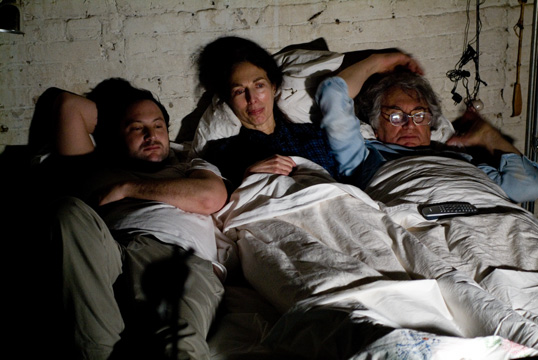
"MOMMA'S MAN"
Budget: very low
In no-budget filmmaking, the great equalizer is location. A great
location can make your life easier while shooting, give you something wonderful and interesting to look at, and, if you're
really cooking with gas, provide you with a unique story to tell. For Azazel Jacobs' "Momma's Man," the root (and stem) of
the making of the film was his main location, his parent's apartment in New York where he grew up. He knew he wanted to capture
this unusual place on film and then tried to figure out a story that he could set there. To be sure, Jacobs' home isn't your
typical Ozzie & Harriet, and neither are his parents. Father Ken Jacobs is a renowned experimental filmmaker and mother
Flo is a frequent collaborator. Their home is a very private place and it was clear to the son that you couldn't separate
the people from the place. So he cast his parents as parents and the story grew from there. Ultimately, he wrote about a
character that he didn't know--a married man who comes home for a brief trip, but then has difficulty returning to his responsibilities
of wife and family. There was no casting on the film--Jacobs had worked with lead actor Matt Boren before and he wrote the
part for him. Immediately after completing the script he gave it to Boren and cinematographer Tobias Datum, a classmate of
Jacobs from AFI. A German now living in LA, Datum had shot the Sundance feature "How The Garcia Girls Spent Their Summer"
and the Toronto feature "Drama/Mex," and had also helped out on Jacobs' previous feature, "The GoodTimesKid."
Even though it was clear the film was to be made on a low budget, the decision to shoot on Super 16mm was an easy one.
Jacobs' father shot on film, his earliest memories were of his father shooting on 16mm, they never owned a VCR, and in a
way, the apartment was built on film. Jacobs had shot the $10,000 "GoodTimesKid" on 35mm short ends, so he knew how to work
with those limitations. In fact, as an artist, Jacobs needed those kinds of limitations in order to create. To Jacobs, "limitations
are a blessing. People with money? I wouldn't wish that on my worst enemies." "Momma's Man" was shot in 18 days in New
York and three days in LA with a crew of 10-12 people. Crew members were paid and the film was shot using the SAG Ultra-Low
Budget contract, though several key cast members were not SAG, such as his parents, and his best friend growing up in a memorable
role. They worked unrushed 10 hour days and crew members were given $10 and sent off for lunch, rather than figure out a
catering situation. Datum and one assistant lit the sets minimally with mostly China balls since there was not much electricity
in the place. Money came from a group of experienced producers who believed in the film and the filmmakers and were willing
to risk the small budget because making their money back was not the number one priority.
The film was processed at Duart and edited for 2 ½ months in LA on an Avid Express. After getting into Sundance, the
decision was made to blow it up to 35mm, which doubled the budget. They saved money doing it the old-fashioned way, optically,
which pretty much no one is doing anymore. Post sound was completed at Sound Lounge in NYC and the print was finished on
January 10th, about a week before their first screening. "Momma's Man" connected with audiences in a deep and personal way,
and also appealed to fans of Ken Jacobs--the film takes a fascinating journey through an incredible work/live space, one like
you've never seen before. A kind of magical emporium or creativity museum. Certainly a good inspiration for a movie. Kino
bought "Momma's Man" (from troubled ThinkFilm) and has been screening it theatrically around the country. It premieres on
DVD May 5, 2009
COMING
SOON TO DVD!
(Click the image below for more information:)
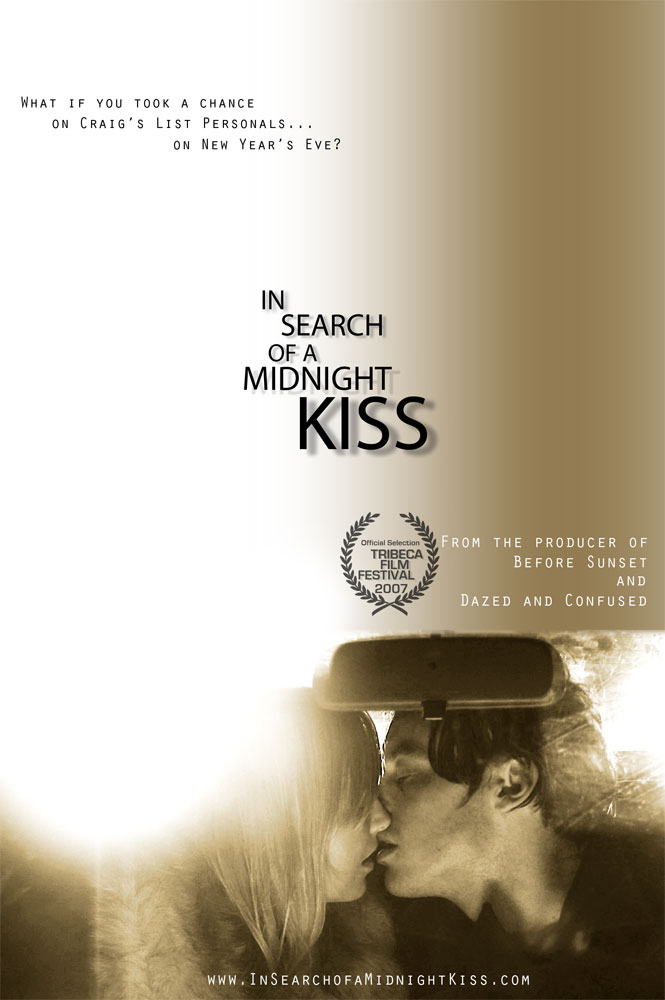
"IN SEARCH OF A MIDNIGHT KISS"
Budget: $15,000
Usually when I hear "indie romantic comedy," I go running for the hills. I saw a lot of bad low-budget romcoms when
I was at Next Wave, enough to almost turn me off of the genre altogether, (and then I see "Pretty Woman" and all is right
with the world). Mostly this is because you have filmmakers trying to make studio romantic comedies without the writing,
the acting, and all the other things that good, solid, commercial romantic comedies have. They're almost always bland, pedestrian,
milquetoast, and SOFT--all things that micro-budget films CAN'T be to survive. So you can imagine how pleasantly surprised
I was when I saw Alex Holdridge's delightful (don't get the wrong idea) no-budget romantic comedy at the 2007 AFI Fest. Sure,
it was made the way I like--tiny crew, running all over LA without permits--but it was also smart, edgy and funny as hell.
Exactly what a successful no-budget film should be. Inspired by his cameraman friend's pronouncement that he had just purchased
a Sony Z1 HDV camera, Holdridge wrote the 130 page script in two weeks and immediately got his actor buddies together and
started shooting. The $15,000 film was shot in a total of 16 days. Working with a tiny crew, Holdridge shot all over Los Angeles
sans permits. The film crushes the notion once and for all that micro-budget films need to be set in one location. Quite
the contrary--the less you have, the more you can go anywhere, and this film demonstrates that--restaurants, subways, downtown
streets, the Orpheum Theater, the Disney Concert Hall, the Santa Monica Ferris wheel, and other public spaces. One of Holdridge's
secret strategies for shooting on private property downtown was to first put the camera on a tripod, (even though the film
is mostly hand-held), then when a building security guard would come out to complain, he would tell them they were shooting
a wedding video and ask if they could continue shooting if they took the tripod away, and the guard would say ok. Actors
were on wireless mics and the guy holding the bounce board would slip in at the last minute. One trick for shooting on the
subway was to put a tall guy in front of the security camera.
In the best sense a modern romantic comedy, (as one review says, "mixing romance with frank sex talk"), Holdridge
chose to release the film in B&W to give it a timeless quality, and frankly, Los Angeles has never looked so interesting.
He achieved winning performances from his talented but unknown cast, with which he has worked on several films. "Midnight
Kiss" premiered at Tribeca and won several festival awards before getting picked up for domestic distribution by IFC Films.
Unlike most indie comedies, the film has had terrific success overseas, becoming a hit in places like Greece and the UK. Paul
McCartney was reported to be a big fan after seeing it there, despite the fact that there's a big Beatles poster on the wall
in one scene and no release. Whoops!
The filmout
to 35mm was done at Fotokem and unfortunately, despite the initial "I", which is supposed to stand for "Independent", distributor
IFC Films plans to show the film in color on VOD and their cable channel. So unless you caught it in the theaters, you missed
that nice B&W look. Still, this is a great film with hilarious characters and situations, and wonderfully subversive
dialogue, which will sound just as good in color. As a testament to its quality, "Midnight Kiss" won the prestigious Cassavetes
Award at the 2009 Spirit Awards, given to the best film made for under $500,000. And made for WAY-under $500,000, too.
NOW
AVAILABLE ON DVD!
(Click the image below for more information:)
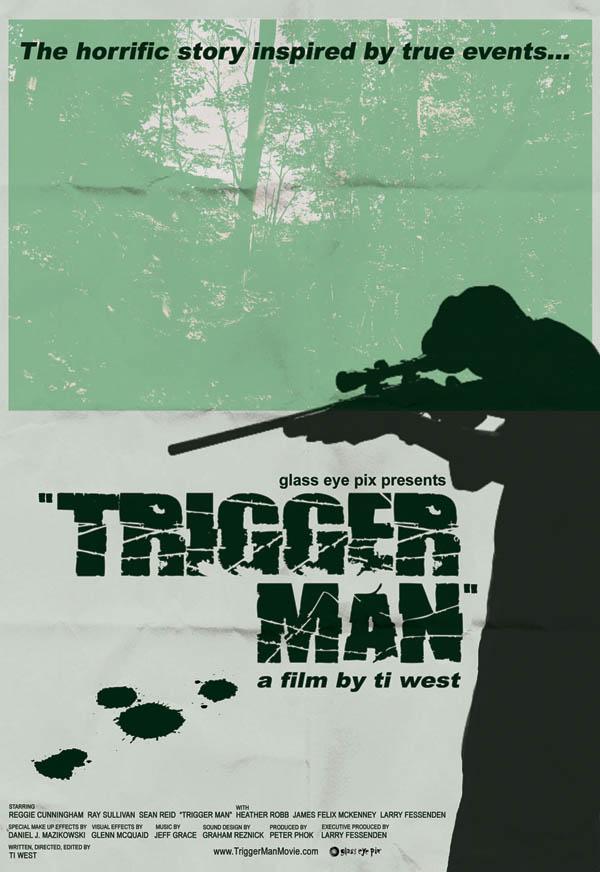
"TRIGGER MAN"
Budget: Very Low
Director Ti West made his debut at LAFF in 2005 with his 1980's horror
throwback "The Roost," which was produced and financed by Larry Fessenden's genre production company, Scareflix. The $50,000
Super 16mm feature met with great success and was picked up out of the festival by Showtime Networks and Vitagraph Releasing
in a mid-six figure deal. Pretty good for a kid right out of college. But as many filmmakers will tell you, the second film
is always harder to get off the ground. In Ti's case, the success of "The Roost" meant more money for his next film, but with
more money came more hassles and the whole project became such a nightmare to get off the ground that he put it aside and
called Larry up for another no-budget go-around. Not wanting to repeat himself, he was inspired to make an existential horror
film in the vain of Gus Van Sant's "Gerry" or Kelly Reichardt's "Old Joy" (both conspicuously not horror films). Larry was
intrigued and so Ti wrote the script in ONE day and came back to Larry with a cast, a location, and his 18 page script ready
to go. Yes, 18 pages. There's not a lot of dialogue in "Trigger Man" and the script is more of an outline for a movie. Borrowing
Scareflix's Panasonic HVX-200, Ti, his actors, and the tiny crew (Ti, who shot the film; a producer/boom operator; and the
special effects makeup guy) shot for seven days in June 2006 in New York City and Delaware. The whole impetus for the film
originated from it's chief location, an abandoned mill and the adjacent woods that Ti grew up near. He always knew it would
make a great location for a film and figured he would be able to shoot there hassle-free. Well, it almost worked out that
way. On their final day of shooting, some people reported that there were strange men running around with rifles and five
cop cars pulled up with guns blazing during the martini shot and forced the cast and crew on the ground. Fortunately they
had a permit to shoot there and everything was straightened out soon enough.
West paid everyone $100/day and used
only the minimum number of people necessary to get through each shooting day. The film was made using the SAG Ultra Low Budget
contract, but only Fessenden was SAG and he only worked one day, (Larry's an accomplished actor as well as a producer and
director). The rest of the cast were friends. Everyone ate coffee, juice and donuts in the morning, made sandwiches for lunch,
and then were treated to dinner each night by West. The effects makeup, which is impressive, was only about $2,000 and even
though the makeup artist didn't have a license for squibs, he was able to achieve an impressive result using a homemade mousetrap
rig. The Panasonic DVCPRO HD HVX-200 was fitted with a Firestore portable hard drive and sound was captured by a mic mounted
to a boom and also a shotgun mic mounted to the camera, and both were fed directly into the camera. Ti shot handheld for an
intentional video-y look and then edited the footage in a month on an Avid. West then worked with fellow Scareflix filmmaker
Graham Reznick on the sound design and they performed a Dolby 5.1 sound mix in three days at Dig-It Audio in New York. "Trigger
Man" premiered at SXSW and garnered quite a bit of attention at LAFF, where an extra screening was added. The film is currently
available on video.
NOW
AVAILABLE ON DVD!
(Click the image below for more information:)
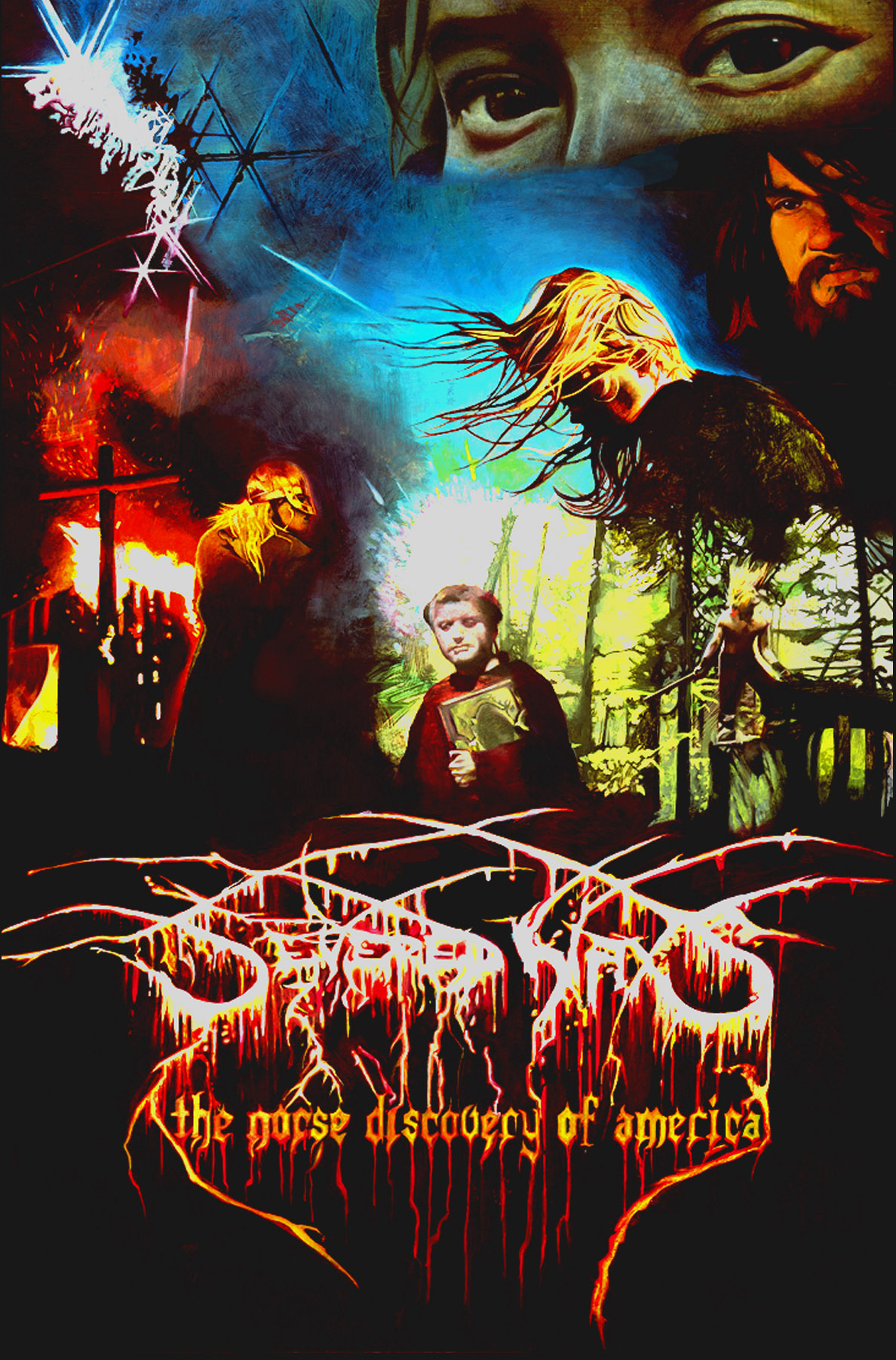
"SEVERED WAYS"
Budget: very little
One of the highlights of the 2007 Los Angeles Film Festival for a lot
of folks was multi-hyphenate filmmaker Tony Stone's "Severed Ways: The Norse Discovery of America." Most people shooting with
no money and no crew on a standard def video camera don't choose to make period pieces, especially ones set in 1000 AD.
But after viewing Stone's effective and authentic rendering, I'm forced to ask myself, "why not?" As I teach in my classes,
once Stone decided to make a movie, he made a resource assessment--"what do I have to make a movie with?" Like Ti West's "Trigger
Man," Stone started with a location he knew well and had access to, and the idea for the story grew out of that. Stone grew
up in New York City, but spent every summer living in a "hippy" house his dad built in the woods of Vermont, "off the grid"--no
roads, no running water (not even a well, they collected water from the roof), no electricity other than solar power. Always
fascinated with the Vinland Sagas, the stories of the Vikings' discovery of North America, and of movies and music about Vikings,
Stone decided to tell the story of two Vikings left alone in the woods to fend for themselves against native American tribes
and other dangers. The idea of making a period genre film on video intrigued him--he saw it as an opportunity to do something
different, open things up, and not make the characters so stiff. He wanted his characters to be relatable, to seem like people
of today; he didn't want to put up a wall to the past. While he went to great lengths to tell the story in a realistic, factually
accurate way, he also used modern heavy metal music in the score as a way of reinforcing the characters' belief system. And
while they speak in the Old Norse language, the subtitled English translation uses a modern vernacular. Rather than coming
off as a hokey anachronisms, these choices worked extremely well, further enhancing the authenticity of his characters.
He commenced shooting in October 2003, thinking it would take him 2-3 weeks and he'd be done. He started shooting in
a loose, spontaneous, handheld style but became bored with that in a couple of days. He realized he wanted to portray his
characters in an existential way, as if the environment were observing these small, ant-like people. A more formal style
of shooting--stationary wide shots and long takes--worked far better than the naturalistic camerawork. The film was shot
on two Panasonic DVX-100's in 24p mode (not advanced, because at the time there was no way to pull out the flagged fields)
and cropped to a widescreen 2.35 aspect ratio. In order to get as shallow a depth of field as possible, they used ND filters
with a matte box to allow them to shoot with low F-stops. The tiny crew consisted of Tony, who played one of the two Vikings,
two camera operators, a sound guy who was not a professional sound guy, (a shotgun mic was mounted to the camera and a boom
was used occasionally), and a producer. They used two fluid head Bogen tripods and while they didn't have a jib, they created
some pretty cool moving shots mounting the camera to zip cord and hanging it from trees. Sometimes a Jeep was used as a dolly.
There was no other equipment and no lights--in fact, there was no electricity, the camera batteries were charged using solar
power. Everyone worked for free, though Stone helped them out with rent money while they shot. About a third of their budget
was spent on food and "recreation"--someone would go into town and shop and they would cook in the cabin they lived in during
shooting periods, the same cabin Stone spent his summers enjoying. One of the biggest expenses was props and costumes. A
number of key props, like shields and axes, were found online, while the costumes were built by Stone and his grandmother.
Rather than one fall, it took three and one harsh winter to shoot the film, leaving Stone with 300 hours of material. Stone
would edit the material in the periods between shooting.
One of the most amazing features of the film is its authenticity. More than any film I've seen of people surviving in
nature, "Severed Ways" makes you understand what it must have been like to live in an environment where your everyday survival
is in question. Stone creates this empathy by showing the day-to-day processes and the unrelenting brutality of this existence,
the stuff that most films leave out. Everything you see the characters do, Stone and his fellow actors are actually doing,
like chopping down trees, building lean-tos, killing chickens, crapping in the woods, and trudging through the snow. The
blisters on hands are not a makeup effect; in fact, the tops of Stone's hands are still numb from lying in the snow, on a
day where he got hypothermia and nearly died, out in the middle of nowhere as they were. Stone edited the film on Final
Cut Pro, performing all the sound design and initial color correction himself. He met a couple of producers in Summer 2006
who gave him a bit of money to do a final sound mix and color correction and upconvert to HDCAM. LAFF was the world premiere
of the film.
Magnet Releasing, the genre arm of Mark Cuban's Magnolia Pictures, released the film in a limited run in 2009 and now
it's available on DVD.
NOW
AVAILABLE ON DVD!
(Click the image below for more information:)
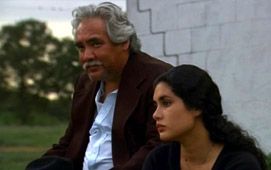
"AUGUST EVENING"
Budget: a bit over $40,000
The winner of the Target Filmmaker Award at this year's LAFF, a $50,000
prize, cost barely more than the prize money. Director Chris Eska's debut feature has uniqueness, authenticity, and grace.
Its uniqueness comes not in it's form, but in the nature of its central relationship, that of an older, undocumented Mexican
worker and his recently-widowed daughter-in-law. Eska was able to achieve a high level of believability by casting mostly
non-actors and by taking his time to let the story unfold, yielding truths about the characters and their environment through
subtle details rather than heavy-handed dialogue. While the production shot for a spacious 30 days, luxurious by most no-budget
standards, there was nothing relaxing about shooting 180 scenes in 70 locations with 50-60 speaking parts in five six-day
weeks. Eska shot in his home state of Texas in August and September of 2005 with an all-volunteer cast and crew. While they
rented the Sony F900 HD camera, many other key production items were procured for free, like meals. Generally food is anywhere
from 15-25% of a no-budget film's total production budget, but Eska enlisted the fine ladies of Gonzales, Texas to cook meals
for free. The community helped out in other ways, as all locations were free, including a chicken farm, factories, stores,
and several homes. The cast and crew created a kind of hippy commune during the shoot, staying in rented houses, cooking
and cleaning together, with older people mentoring the younger ones. Eska insisted on working with people who related to
the material and were not looking at his project as "just another job." These volunteers included recent college grads who
drove all over Texas for a month scouting locations and several first-time crew members. For the inexperienced, Eska held
a miniature film school during rehearsals, teaching skills like how to light and hold a boom mic. The moving subject matter
enabled the production to get many things for free--everyone who was asked to help could relate to the numerous family-oriented
issues of the film. For example, all props and costumes came from thrift stores, but the stores ultimately donated the items.
Certain things were difficult to come by without paying: 70 HDCAM tapes to capture the 55 hours of footage shot, some plane
tickets from LA, a rented 15' Uhaul truck and the G&E equipment inside, three SAG actors who were paid using the Ultra-Low
Budget contract, and production insurance, which was a big expense at $7,000. With all of that, they were still able to get
the film in the can for under $40,000--very impressive for an HDCAM feature with the scope of this one.
The production rented a Sony J-H3 playback-only HDCAM deck (cheaper than the player/recorder models) to ingest the footage
into their desktop editing system. They edited the downconverted 29.97 footage on Adobe Premiere Pro and conformed it at
Jacob Rosenberg's (a guest speaker in my first class) Bandito Brothers post studios using the Cineform codec. They screened
a 24 frame 1080p HDCAM at LAFF. While some people insist that you have to spend $50,000-$100,000 in post once you get accepted
into a major film festival, "August Evening," like many other films, proves that is unnecessary. Chris did all the sound
design, editing and mixing himself using Adobe. He pulled many sound effects from effects library CD's and the rest were
recorded by his production sound mixer. There was no foley done and the handful of ADR lines were recorded in an LA hotel
room and at his house. No real color correction was done on the film, other than a few shots here and there that were problematic.
Music was gathered from a number of artists Eska met over the years; composer Jonathan Hughes scored several cues in Buffalo
and emailed the files to Eska. The film was picked up out of LAFF by Maya Entertainment, a distribution company devoted to
delivering product to Latino audiences. It was released theatrically throughout the country and played many special screenings.
The film was won the coveted Cassavetes Award (best film under $500k budget) in the 2008 Spirit Awards. It became available
on DVD in January 2009.
NOW
PLAYING IN THEATERS!
(Click the image below for more information:)
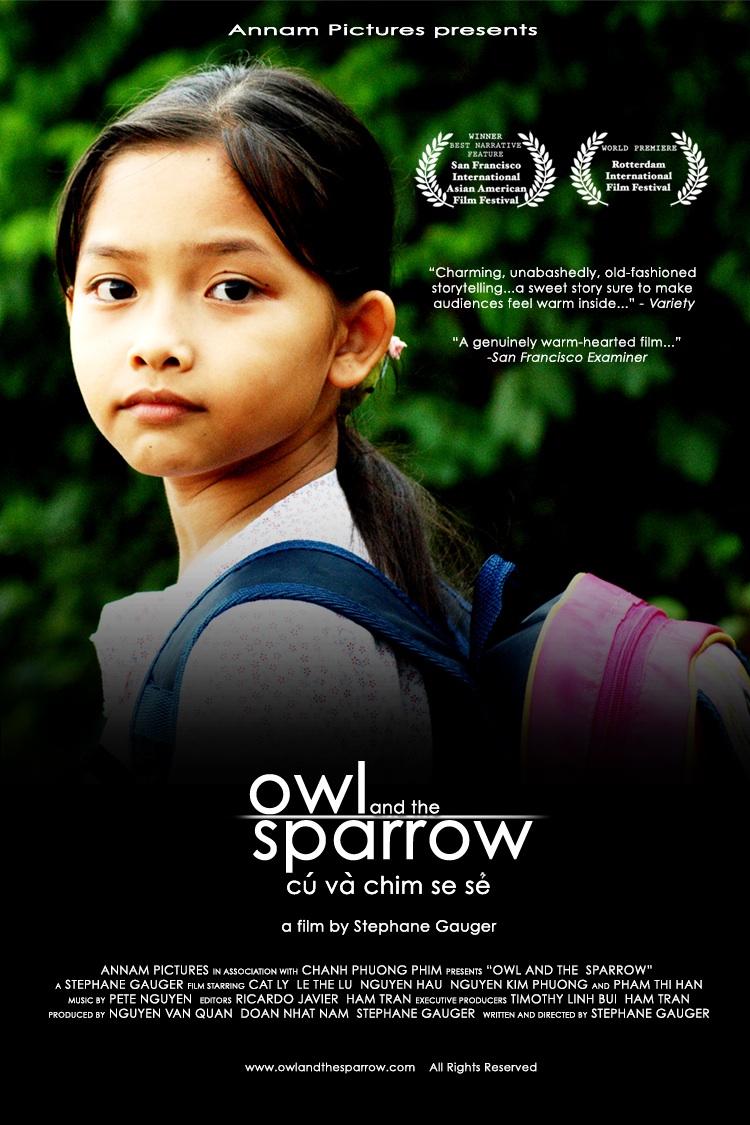
"OWL AND THE SPARROW"
Budget: on credit cards
Inspired by the verite-styled Michael Winterbottom film "Into This
World," as well as the French New Wave, director Stephane Gauger was eager to tell a low-tech, low-concept story about his
native Vietnam. Of course any film set in modern Saigon is exotic to American audiences, even one revealing the simple rhythms
of everyday life. After working as a camera operator on the Vietnamese-set action film "The Rebel," the biggest budgeted
Vietnamese film to date, Gauger was ready to go the opposite way with his story and let the people and the place do all the
heavy lifting. After completing the script in the Fall of 2005, Gauger used his time working on "The Rebel" the following
Spring to find crew members, supporting cast, and locations. Official prep time was only two weeks and filming commenced
May 1st 2006. The nine-man crew, (director/A-camera operator, B-camera operator, gaffer, boom operator, PA, locations manager,
AD, and two producers) shot in over 30 locations in just 15 days. The story of a 10 year old runaway who brings together
a beautiful flight attendant and a lonely zoo keeper, Gauger knew the keys to success were realistic performances and the
audience's immersion into the bustle of modern-day Saigon, a city of 8 million people. Though the dialogue was 95% scripted,
(the Ministry of Culture must approve all scripts and then you have to adhere to it), Gauger was able to get a natural performance
by running two cameras simultaneously--one Panasonic DVX-100 shooting a wider master shot, and the other shooting close-ups,
panning and fishing for little gems of emotion. Sound was captured by a boom mic and recorded directly into the camera.
Originally Gauger wanted to cast an actual flower girl from the streets, but he worried a non-actor wouldn't be able to carry
such a difficult and important role. Two days before shooting they found young Pham Thi Han, who is wonderful in the film.
Cast and crew were all paid, but the rates in Vietnam are very low. The production also paid for locations, permits, tape
stock and transportation, but that's about it. The cameras were borrowed, there was no insurance, and the producers bartered
for food, paying to eat in return for free access to the restaurants for shooting.
The film was edited in Los Angeles in the Fall of 2006 on Final Cut Pro and one of the producers was able to get a free
film transfer in India at Digiquest Studios. The negative was printed in Bankok, just in time for their second screening
at Rotterdam, where "Owl And The Sparrow" premiered. The film played several other festivals before winning the narrative
audience award at LAFF, and was also nominated for the Cassavetes Award at the 2008 Spirit Awards. It is now being released
theatrically through Wave Releasing, who are targeting the Vietnamese audience, and beyond. Gauger is in pre-production on
"Powder Blue," a script he co-wrote with Tim Bui ("Green Dragon"), which Bui will direct with actors Forrest Whitaker and
Jessica Biel.
NOW
PLAYING IN FESTIVALS!
(Click the image below for more information:)
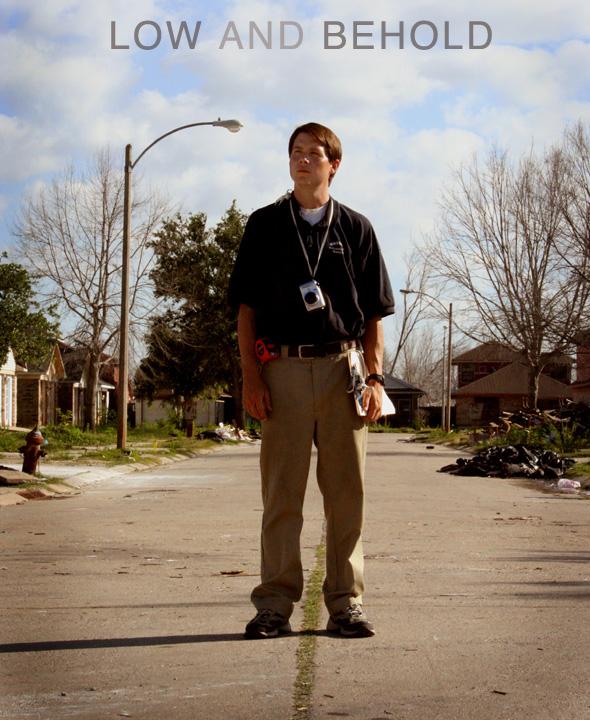
"LOW AND BEHOLD"
Budget: low!
One of the highlights of the 2007 Sundance Film Festival was the little-talked about Spectrum feature LOW AND BEHOLD. Set
in post-Katrina New Orleans, this comedy/devastating drama (you just can't call a film like this a "dramedy") wowed
the packed screening I attended near the end of the Festival. Though not officially produced by David Gordon Green, his influence
is all over the film and his name was mentioned about 17 times during the Q&A afterwards.
Director Zack Godshall got the initial idea to shoot a fictional film in a non-fiction environment with his UCLA film
school graduate thesis film, which was set at a musical festival in his hometown of Lafayette, LA. He kicked around the idea
to make a low budget fictional story with documentary elements with his buddy Barlow Jacobs, who he had cast in his thesis
film. After Katrina, they discovered New Orleans would be an ideal real-world environment, with plenty of (free) production
value found in the events going on following the hurricane. Barlow, who was living in New Orleans when the storm hit, got
a job in Florida as a claims adjuster and soon after realized it would make a great basis for a script--the stranger in a
strange land who becomes the eyes and ears of the audience, guiding them through all the madness. When some free high def
equipment fell through, Barlow used the $25,000 he had made claims adjusting to buy a Panasonic HVX200, three 8GB P2 cards,
a Mac G5 editing system, an HD monitor, and several external drives. The script was written around things they had available
to them and crew who were willing to work for next to nothing were recruited. Barlow took out a loan to pay for other production
expenses, of which food was the biggest, of course.
Barlow played Turner Stull, the naïve claims man, and Barlow's fellow cast member from "Great World Of Sound,"
Robert Longstreet was coaxed into playing his uncle who runs the firm. Green was instrumental in getting Eddie Rouse, one
of his actors from "George Washington," to come down and play Nixon, who recruits Turner to help him find his lost
dog amidst the rubble. The initial 25 day shoot began in May 2006 with a crew of more or less 9 people. A smaller 3-man
crew spent another two to three weeks getting unscripted things that would be potentially interesting. The SAG Ultra Low
Budget agreement was used to govern the few SAG actors they had, but many people who appear in the film are actual residents,
telling their own stories of devastation and destruction. One of the keys to success was getting good performances from non-actors
and natural performances from real actors and making it all seamless. Zack knew from the beginning that he wanted an understated,
truthful performance that would blend in to the reality of the real-world backdrop. Much effort was given to sculpting this
kind of performance and anything that was unauthentic was cut from the film. Working with the non-actors, Zack discovered
that you couldn't direct them too much or they would become self-conscious and give a phony performance. A hands-off approach
was the best method.
DP Daryn Deluco had very little time to test the relatively new HVX200, but he compared 720p with 1080p and felt like
there was enough of a difference to go with the higher resolution but less efficient 1080p, giving them only 8 minutes of
footage per 8 GB card. Much of the film was shot in natural daylight and there was no crew or gear to control bringing down
the ambient light levels, though a large silk was used in one scene. Mostly a single bounce board was used to bring up the
level in the shadows. Interiors were lit with natural light or with a Kinoflow and a small light kit that one of the producers
owned, with a china ball used extensively. There was a designated person on set downloading the material off the P2 cards
onto a G4 laptop with a built-in card slot. The footage was imported directly into Final Cut Pro and was therefore automatically
copied onto an external LaCie drive. At the end of each day, that drive was backed up onto another larger LaCie. Seeing
the film projected on HD at the festival, I imagined it was made with one of the new, small HD cameras, but I couldn't find
any of the tell-tale signs of a 1/3" chip, like noise in the lowlights. The film looked so amazing that I just assumed
it was shot with a full-bore HD camera like a Sony F900. I was exceptionally pleased to see it was shot with the camera that
I have been recommending in my classes. People, don't waste your money shooting on film or HDCAM! You cannot believe how
good this camera's image can look.
Editing started in earnest in July with editor Travis Stittard (an assistant editor on Green's "Snow Angels")
splitting time in Los Angeles and New Orleans. Godshall utilized two mirrored sets of hard drives when the two were in different
cities. Green's producer Lisa Muskat helped Godshall find finishing funds through a company called Sidetrack Films. That
money helped pay for the post sound work--which was done at New Orleans' Swelltone Labs, Steven Soderbergh mixer Larry Blake's
company--color correction and conversion to HDCAM at Deluxe Digital Media, and other sundry items like website design, posters,
and postcards.
The film premiered in the Spectrum section and my first question at the Q&A was, "why was this film not in Competition?"
Playing only three times in Park City and mostly near the end of the festival when everyone had left, "Low And Behold"
was one of those films that quietly plays Sundance. It happened to be my favorite film of the festival: wonderfully realized,
tonally pitch perfect, simultaneously hilarious and brutal, beautifully shot, and exceptionally well-acted. The subject matter
is timely and relevant, with Godshall capturing the devastation and the spirit of the area and its people better than any
documentary I've seen on the subject. "Low And Behold" is no-budget filmmaking at its finest.
NOW
AVAILABLE ON DVD!
(Click the image below for more information:)
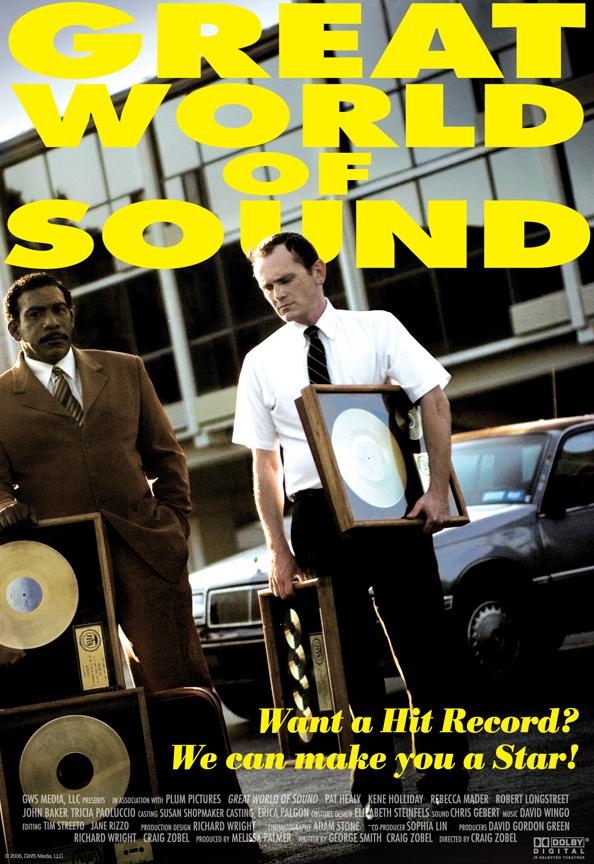
"GREAT WORLD OF SOUND"
Budget: low!
Part of David Gordon Green's North Carolina mafia (graduating from
North Carolina School of the Arts [NCSOTA] a year or so after Green, director Craig Zobel spent several years learning production
before finally making his first feature. Having worked on several of Green's films (he was the production manager of "All
The Real Girls" and "Undertow") and making a name for himself as an AD in New York, Zobel became interested in how you can
make a movie for less--playing around with the schedule, giving yourself "free" time, etc. Inspired by an actual incident
involving his father in the 1970's, Zobel began writing the script for GWS several years ago, eventually bringing in college
pal George Smith to help him finish. GWS deals with a shady music producing company that preys on both its salesmen, who are
recruited at the beginning of the film, and then on the hundreds of wannabes trying to make it in the music business, in a
practice commonly known as "song sharking." Zobel was inspired by the classic 1969 Maysles documentary "Salesman," and wanted
to portray on film that uncomfortable feeling of not letting your "mark" say no. He thought the best way to capture that
atmosphere would be by using a hidden camera, and having real people "play" the hopefuls. He figured this technique would
also help him keep the budget low--he wouldn't need to cast famous actors to play the two lead salesmen characters because
the real people would recognize them. Of course, without name actors the budget would have to be kept low, so Zobel used
all his skills as a production manager and called in all his friends to help him shoot it. Casting was done in New York where
Susan Shopmaker's casting associate Erica Palgon agreed to cast the film. With most of his friends living in Charlotte, NC,
pre-production began there in September 2005. Zobel's budget for the film came out to be about three times more than he had
in savings, but he decided to move forward with the money he had and just find ways to make it work. Two ideas were instrumental
in his eventual success: 1.) he divided the production into two parts, taking a break in between to regroup, and 2.) he
rented an office/warehouse that would act as their production offices and house many of the sets they needed to build.
Using most of the money in the budget, Zobel built three elaborate sets in the warehouse section of their building for
the hidden camera portions of the filming. Each set incorporated two-way mirrors equipped with three borrowed Panasonic DVX100
cameras behind them, two on dollies, one on a tripod. One set was meant to look like the song sharks' office, and the other
two were to look like motel rooms. In one of those sets, a microwave's guts were cut out and a camera was hidden inside.
Star-struck locals who answered ads seeking aspiring musicians came in to audition, unaware that their performances were being
taped or that they were really part of a feature film, rather than trying out for a music company. Of course the 65 or so
intrepid performers were eventually told that they were participating in a film that was determined to expose the practice
of preying on hopeful wannabes, and nearly all signed releases to be part of the project. All the hidden camera scenes and
a few others where they utilized the video cameras were shot in the first half of their production, which took 12 shooting
days.
The production then took a month off to prepare for the second part, which was shot on Super 16mm (Fuji 500 speed). Because
he was not paying his crew, the month off allowed him to recruit new crew members, and gave him time to raise some additional
money from family and friends. The second half of the shoot was 11 days and they grinded out 67 pages of script. While these
days sound brutal, Zobel says that only one was longer than 12 hours. Because he wasn't paying any of his crew, he knew he
couldn't abuse them the way many do on these kinds of shoots. Looking back, Zobel admits that shooting on 16mm was a mistake,
even though he likes the look of film. There ultimately wasn't enough of a difference between the DVX material and the 16mm
material, and mixing the two provided extra headaches and substantial costs in post.
Because the director was not in the room during the hidden camera shoots, Zobel devised a clever way to communicate with
his actors--he would call them on their cell phones while the cameras were rolling and give them notes. Several of these
moments are in the film, with the actors pretending their office was calling them. Of course these hidden camera portions
of the film are completely improvised. The actors were given materials on song sharking and salesmanship, with even Zobel's
dad, a professional salesman, giving them tips. Over the course of the shoot, the two actors became VERY good song sharks!
In addition to being both hilarious and heartbreaking, the performances from the real people set a high standard for the
rest of the acting in the film. Zobel went to great lengths to obtain utterly authentic performances from his talented cast
of professional actors in the scripted portions of the film, insisting they make the words their own in an effort to achieve
the required naturalism. Like Green, Zobel doesn't hold his own written words too dearly; he doesn't care that the actors
change the lines as long as it sounds authentic. The triumph of the performances in GWS can not be overstated--many scenes
involve real people who do not know they are being filmed interacting with two actors "performing," and the line between the
two types of performances is seamless. Kudos to the two leads, Pat Healy and Kene Holliday (whom you may recognize from the
late-70's sitcom "Carter Country"--if you're as old as I am!), who give endearing and affecting performances as the two salesmen
who are scammed into scamming poor souls out of their money.
The 17 hours of 16mm material was processed in Atlanta and telecined to DVCAM where it was combined with the over 210
hours of DVX100 material and edited on Final Cut Pro. After the cut was locked, Zobel went back out to raise more money to
finish post. Eventually, the MiniDV selects were upconverted to HD on D5 and the 16mm selects were scanned to D5, then the
conform and about 40 hours of color correction were done in a DI suite at PostWorks in New York. The post sound work was
performed at Juniper Post in LA. The film premiered in the Spectrum section of the 2007 Sundance Film Festival, and a distribution
deal with Magnolia was announced for the film at SXSW. The advance will helped pay back investors and also the crew, who
were given producer's points in return for their services. Magnolia released the film theatrically in the Fall of 2007, and
the film played numerous festivals winning several awards. Craig won the prestigious Best Breakthrough Director Award at
the Gotham Awards and the film was nominated for two Spirit Awards. Craig was named one of Filmmaker Magazine's 25 New Faces
of Film, so we will surely be seeing more from him.
NOW
AVAILABLE ON DVD!
(Click the image below for more information:)
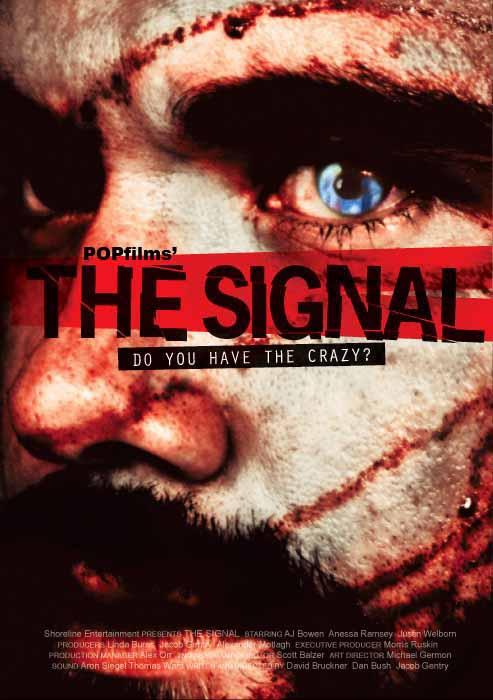
"THE SIGNAL"
Budget: Low
The big no-budget success story from the 2007 Sundance Film Festival
was the Atlanta-based horror film "The Signal," co-directed by a trio of filmmakers and shot with the new Canon XL H1 HDV
camera. The film was picked up for a reported $2 million by Magnolia. Of course now that there is big money involved, everyone's
getting cagy about the film's no-budget origins, especially the distributor, (does no one remember that film set in the woods,
you know, with the sticks, did like $150 million domestic, cost like, nothing?). Anyway, I don't have to tell you that an
Atlanta-made horror film shot on a Canon with no stars wasn't made for a million dollars. And if you're reading this, you
don't care. You'd want to see it even more if you knew that it wasn't, right? Also go see it because it's scary and entertaining,
and because the script was designed with a low budget in mind, which actually is one reason it is scary. The production problem
from the beginning was how do you explain something apocalyptic on a small scale? You follow the characters closely; you don't
show what's around the corner unless the character sees it. Because there wasn't the money to "show everything," the question
became, is it better to see it and not believe it, or show nothing, or just glimpses, and let the audience's imagination do
the rest? I think you know the answer. The filmmakers (David Bruckner, Dan Bush and Jacob Gentry) shot long days on a tight
schedule in order to capture the complex script. Much of the film is set in and around Bruckner's apartment complex, because
in Atlanta, they were able to do that for free, and so they created a number of "games" within the geography of that environment.
There was one unit and one story, but each director was in charge of directing that story from a different perspective, that
of a husband, a wife, and the wife's boyfriend. Each director shot a different director's scenes in an incredibly unique and
collaborative environment. The uniqueness of the production methodology translates onto the screen in a unique viewing experience.
Magnolia released the film theatrically and now it is available on DVD.
NOW
AVAILABLE ON DVD!
(Click the image below for more information:)
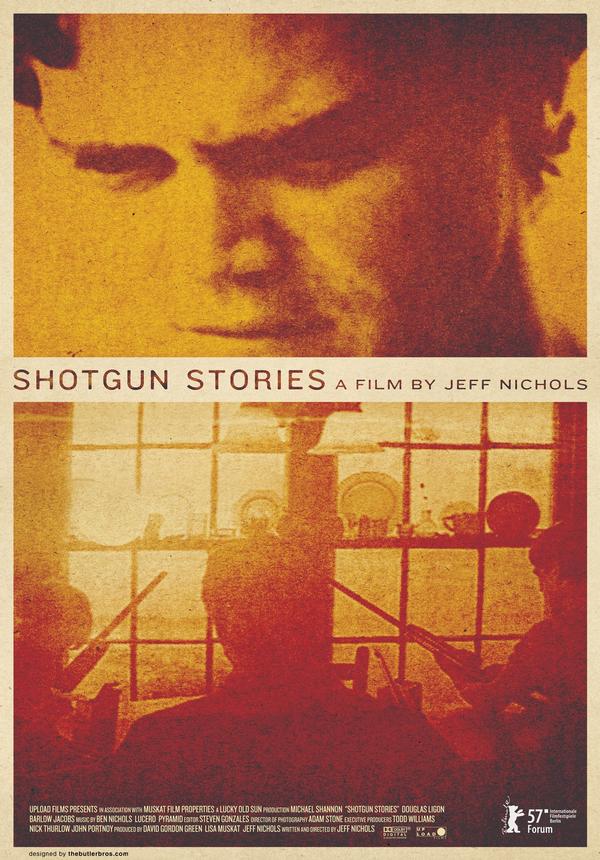
"SHOTGUN STORIES"
Budget: low
Premiering to rave reviews from a variety of international critics
in this year's prestigious Berlin Film Festival, "Shotgun Stories" is set in Southeast Arkansas, where Director Jeff Nichols
grew up. Heavily influenced by David Gordon Green's seminal "George Washington," (Nichols, too, graduated from North Carolina
School Of The Arts a couple of years after Green), and David Lean's "Lawrence of Arabia," Nichols insisted on shooting his
first feature in anamorphic 35mm. Again, like "George Washington," the landscape defines who these characters are--it explains
men in the South and why they do the things they do. The fish farm at which the three lead characters work is very much a
character in the story. Of course, shooting on 35mm with no money has its problems. In this case, unprocessed film sat around
for several months until additional money was raised to develop it. This money and the money to shoot critical B-roll material
a year later came from a variety of friends and family sources in Arkansas--Jeff's parents and girlfriend, his grandmother,
the owner of the fish farm, a police officer--making "Shotgun Stories" regional filmmaking at its best. And to further extend
the David Gordon Green connection: Adam Stone, the DP, was in the same NCSOTA classes as Green's cinematographer Tim Orr,
shot 2nd unit on Green's "George Washington" and "All The Real Girls," and shot Green-produced "Great World Of Sound"; Barlow
Jacobs, one of the leads in "Shotgun Stories," was the lead in "Low And Behold," and was featured in and crewed on "Great
World Of Sound"; editor Steven Gonzales edited Green's first three features; and Green came on board to produce "Shotgun Stories"
with his longtime producer Lisa Muskat. It doesn't get any more incestuous than that! "Shotgun Stories" was released through
Liberation Entertainment and can now be found on DVD.
NOW
AVAILABLE ON DVD!
(Click the image below for more information:)
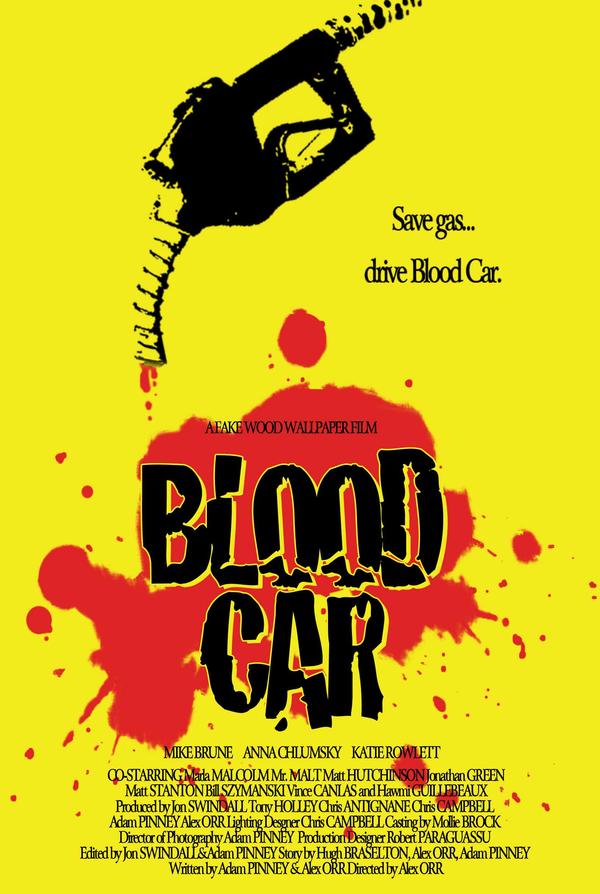
"BLOOD CAR"
Budget: $25,000
Think a filmmaker's lucky if he can get his crew to so believe in his movie that they work for below their rate? Or better
yet, for free? Well "Blood Car" director Alex Orr got the ultimate sacrifice from his crew--they invested cash in the film!
After finishing the script for his first feature, the comic horror film "Blood Car," Orr figured he'd use the $5000 he'd
saved and try to shoot it on DV. After showing it to several filmmaker friends, they thought he had something better and
convinced him to raise more money and shoot it on high def. And then they put their money where their mouths were, investing
in the film and working on it for free to get it made. This close-knit gang of Atlanta-based filmmakers, many, like Orr himself,
who would later work on the hit Sundance film "The Signal," went to film school together at Georgia State and were itching
to do a feature after paying the bills working local commercials and industrials. Orr used his experience in production to
get great deals on gear, including a 3-ton grip truck loaded to the gills from local equipment house PC&E and a Sony F900
package out of New York. Shooting for only 12 days in chilly December, when business is slow, he managed to get through production
for only $14,000. But there's nothing chinzy about the way "Blood Car" looks. The opening scenes include amazing crane shots,
courtesy of a free 30 foot jib they managed to snag for a day. Orr also figured out a way to feed his crew for free--he convinced
the cast and crew's families to each pick a day to cater the show.
Telling the story of a car that runs on blood instead of gas takes plenty of, well, blood, and Orr and his crack team of mechanical
effects guys made plenty of it, from Karo syrup, food coloring and flour, with ramen noodles, small balloons, and bits from
the butcher to chunk it up when necessary. But rather than use it for sadistic thrills like so many recent horror flicks,
"Blood Car" puts it to great comic effect, with a little subtle political "preaching" thrown in for good measure. Set in
the not-to-distant future (perhaps two weeks from now?), "Blood Car" depicts a world where gas prices have gotten so high
that no one can really drive cars anymore. Mild-mannered elementary school teacher and vegan Archie is working on an engine
that will run on wheat grass, but after accidentally cutting himself, he realizes his new invention works much better on blood.
Morally opposed to killing anything, he tries to find innocuous sources of fuel, like his dead neighbor, at first. But he
soon discovers that having the only running car in town is scoring him big points with the local slut in town, and I do mean
SCORE. To keep her interested, he quickly has to resort to more radical measures to keep his car, and sex life, humming.
Throw in some bumbling government types and you've got a hilarious, raunchy romp. The theme of course, as echoed in the
indie feature "Tao Of Steve," is that men can rise to great heights when properly inspired.
Orr was able to finish his film soup-to-nuts on HDCAM for a scant $25,000 total. He was rewarded for his efforts at his very
first festival, winning the New Vision Award at the 2007 Cinequest. The film has played a slew of other festivals and is
now available on Netflix and Blockbuster.com.
NOW
AVAILABLE ON DVD!
(Click the image below for more information:)
"CRASHING"
Budget: $10,000
Think no-budget filmmaking is only for newbies? Not so! Sometimes talented
veterans get tired of the high-budget runaround and they retreat to the creative freedom and control that no-budget filmmaking
affords them. Gary Walkow, director of the 1987 Sundance Grand Jury Prize winner "The Trouble With Dick," got frustrated with
the way movies were being made following the production of his Sundance film "Beat," (starring Courtney Love and Kiefer Sutherland)--the
multiple Executive Producers (several of which he had never met), the escalating budget, the subsequent cutting of funds,
the unwelcome changes to the script, etc. He remembered a simpler time when he made "Trouble With Dick" for next to nothing
on 35mm and yearned to get back to basics, and re-experience the joy of making movies for the movie's sake. Fortunately for
Walkow, technology had come a long way in 20 years and he was now able to make something that looked a lot like his $200k
35mm feature on a fraction of that budget. His buddy and producing partner Alain Silver owned a Panasonic DVX100 and they
decided to write a feature they could shoot with that camera and no crew. They set most of it in Gary's apartment and utilized
their connections to nab several name actors, most notably, lead actor Campbell Scott. Of course, they had to be flexible
to work around Scott's schedule--he doesn't live in LA where the film was shot and there was no money to pay him to fly. They
would shoot his scenes when he was in town doing publicity. The crew started out just Gary, Alain, and DP Andrew Huebscher,
(a guest in my May 2006 class). Realizing they weren't getting the sound they needed, they asked my producing partner (and
two-time Academy Award winning sound mixer) Ron Judkins if he would be interested in running sound, and intrigued by their
methodology, he agreed. I visited the set and if you didn't see the tiny camera, you'd never know there was a movie being
made. Well, there was a movie being made and it premiered to an enthusiastic audience at the 2007 Slamdance Film Festival.
One benefit this incredibly intelligent and literate film gained from its stripped-down production style was that the strong
script and exceptional performances really stand out. And for the majority of us at festivals, those are the elements that
appeal to us the most. There's a great feature story by the LA Weekly to read. Quoting from that story, Scott Foundas writes,
"It is, I think, the best thing Walkow has done; funny and sexy, but also honest and lived-in and knowing of the way writers
draw upon (and sometimes exploit) the people around them for inspiration. It's also, unlike a great deal of what passes for
"independent" filmmaking nowadays, a movie independent not just in its financing, but in its thinking; a highly personal vision
expressed without a second thought given to box office, audience expectations or career advancement." Read the full article:
www.laweekly.com/film+tv/film/the-sundance-kids/15430/ The film was released on DVD through Image.
MISSING
IN ACTION
(Click the image below for more information:)
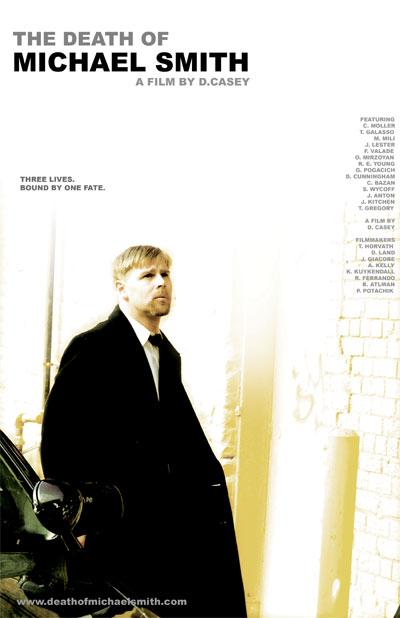
"THE DEATH OF MICHAEL SMITH"
Budget: $541
A recent award winner at this year's Slamdance and Silver Lake Film Festivals, "Michael Smith" is a bona fide no-budgeter.
Multi-talented director (and writer, cinematographer, editor, sound designer, and colorist) Daniel Smith spent $541 to completely
finish his genre film, then another $400 to make a Digibeta to play at the festivals. This is nearly impossible to believe
once you see this stylish and extremely well put-together feature. Shot on borrowed Panasonic DVX-100's in Detroit with an
all-Detroit cast and crew, Casey was able squeeze every bit of production value out of his tiny budget by writing for things
he had available to him, like a couple of cop cars he had access to for an hour from a friend or a snowy property outside
of town he had for a day. A second year fellow at AFI, Casey knows the basics in all areas of filmmaking and used this knowledge
to maximum effect, planning color schemes and sound design patterns prior to shooting. He wrote parts to maximize the talents
of his actors and the performances are uniformly excellent. Shooting on weekends and employing a unique narrative structure,
it would not be a stretch to compare this film to another similarly-made film that I'm intimately familiar with, Chris Nolan's
"Following." "Michael Smith" firmly establishes the 24 year old Casey as a young talent to watch.
MISSING
IN ACTION
(Click the image below for more information:)
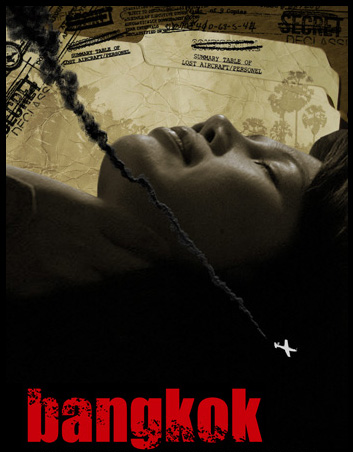
"BANGKOK"
Budget: $20,000
Years ago when people talked about making no-budget films, there was
this idea that to keep the budget down, you had to set your film in one location. I used to hear it all the time at Next
Wave Films--"we've got this great idea and it's all takes place in one room!" Of course, there are two problems with this
idea: 1.) with very few exceptions, these films are pretty stifling, boring even to the most ardent indie film fan; and
2.) the idea that to save money you have to shoot in one location is utter nonsense. The truth is there have been a whole
host of wonderful, vibrant no-budget films that have saved money AND given their films higher production value by leaving
that one room and getting out into the world. Recent examples of films that have used real-world backdrops to enrich stories,
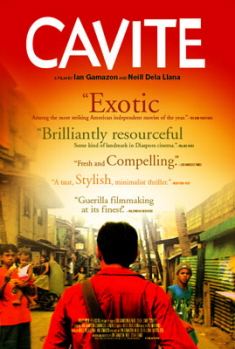
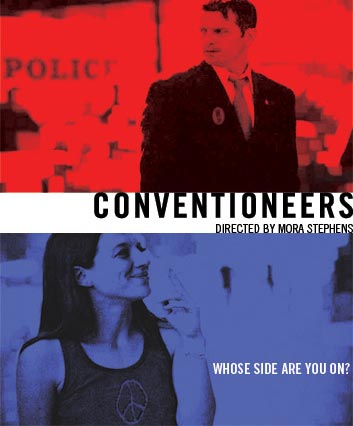
heighten production value, and lower budgets are "Cavite," (set in the Philippines); "Conventioneers," (set during the 2004
Republican Convention); "Low And Behold," (set in post-Katrina New Orleans); "The Pool," (set in Panjim, Goa India); "The
Blossoming Of Maximo Oliveros," (also set in the Philippines); and Colin Drobnis' new film, "Bangkok," set in Southeast Asia,
namely Cambodia.
Of course, the secret to making this kind of film work is to utilize documentary techniques--small, inconspicuous crews;
semi-improvisational dialogue; use of real people as actors--to enable one to tell a fictional story in a non-fiction environment.
Where Hollywood has to "create" the reality of a place, (I've often said in my classes that Hollywood is the Reality Factory,
not the Dream Factory), no-budget filmmakers can sneak into the real place and get something more real, more authentic, and
pay absolutely nothing for all that production value. Well, except for the travel costs. The reported budget of "Cavite"
was two expensive plane tickets to the Philippines. Most of the budget of "Bangkok,"--which director Drobnis estimates to
be around $20,000 but really has no idea--was spent on travel, (and to purchase the equipment--a Panasonic DVX100a, three
wireless mic systems, and some other gear). The film, about a troubled ex-army corporal, Paul, who travels to Cambodia in
search of his long-lost father, who was pronounced MIA during the Vietnam War, was set in the U.S. (Los Angeles doubling for
Alabama), Japan, Thailand, and Cambodia. Paul picks up two unlikely travel companions in Bangkok and the three travel into
the interior of Cambodia in search of Paul's dad, cheap hookers, and new dinner alternatives, (mmmm, fried grasshopper!).
The crew was director Drobnis, who plays Paul; actor Daniel Miller, who plays the bon vivant Reubin; actor Aaron Smith, who
plays the good-hearted, but annoying The Guy; and DP Ilya Lyudmirsky, who has a hilarious cameo as a shady Ukranian arms dealer.
Actually none of the three leads are real actors; they all work together creating visual effects for the studios. Drobnis
is finishing the effects for "Spiderman 3" while his little film plays festivals. This tight-knit team spent 5 weeks in Asia
shooting more than 55 hours of footage, and then Drobnis spent the better part of two years piecing it all together on his
Mac at home. This work included some subtle special effects, plenty of sound design and repair, and color correction.
The director tells production stories about how they had to pay off one guy $150 to get a massage parlor for the day,
then pay someone else $50 for a hotel. They were fortunate to run into Somchai Santitharangkun, who was Oliver Stone's location
manager. In return for some free tennis lessons, "Chai" found them locations to suit their story and negotiated with the
locals. Much of the film's dialogue was improvised and there are some hilarious moments that come out of this work. Daniel
Miller, in particular, is a natural, giving an engaging and humorous performance as the petty thief who is enjoying all the
luxuries of Southeast Asia, but clearly has left some responsibilities back home in the States. Of course, the real star
of the film is Thailand and Cambodia. These are streets and people we really haven't seen before. Even when nothing is really
happening, the film fascinates with the sites, sounds, and customs of a foreign land not often depicted, (or depicted poorly)
in American movies. Director Drobnis got tired of typing his name in the credits, so he made up several names for himself,
(Abel Johnson, the actor; John Penmar, the editor) and came up with a very official sounding production company, World International
Filmed Entertainment. "Bankok" premiered at the 2007 Slamdance Film Festival and played several other festivals throughout
the world.
NOW
AVAILABLE ON DVD!
(Click the image below for more information:)
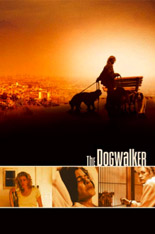
"THE DOGWALKER"
Budget:: under $100k
Filmmakers Alliance (FA) (www.filmmakersalliance.com/) founder Jacques Thelemaques' feature debut "The Dogwalker" has traveled
a long way. Conceived years ago, the film was shot on a Sony DVX-1000 in 2001 and started its successful festival journey
in March 2002, winning a Best Feature Film Award when it premiered at Cinequest. Distribution, however, proved illusive
for the high-quality but commercially-tricky film about a woman's journey from abused wife with no self esteem to empowered,
independent dogwalker. Advances in technology and innovative distribution strategies have finally given the deserving
film a theatrical life. "Dogwalker" will open in several cities through Truly Indie beginning August 11th. The
filmmakers (which include lead actress Diane Gaidry, FA co-founder and wife of Thelemaques), have put together an inventive
release plan that includes building online communities of groups with an interest in the subject matter of the film, including
animal rescue and welfare groups, cancer relief organizations, and women's shelters/domestic violence organizations.
Organizations will create reciprocal links with the "Dogwalker" site, help put on charity screenings that benefit the organization,
and share in the DVD revenues by helping market to their member base. "The Dogwalker" played theatrically in several
cities during the Summer of 2006 and is now available on DVD through their site.
NOW
AVAILABLE ON DVD!
(Click the image below for more information:)
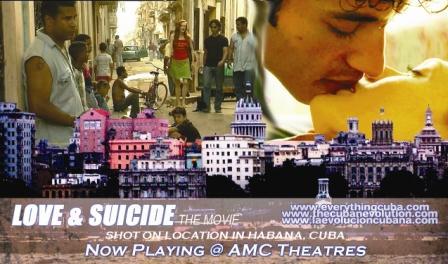
"LOVE & SUICIDE"
Budget: the cost of tape
Wanna know how to make a no-budget film? In my class, the answer to that question is "Refuse to spend money." Luis Moro, the
producer of "Love & Suicide" has another answer, "Raw not giving up!" Certainly both answers are true, and "Love & Suicide"
is perfect evidence. A dream of Moro's since he was a kid, shooting in Cuba is verboten for Americans since the Cuban embargo
of 1960. So how did this tiny production with no money and no influence manage to become the first American narrative feature
shot in Cuba in 47 years? The story behind the making of the film is as interesting as the film itself. Moro and director
Lisa France applied to the Havana International Film Festival with their earlier film "Anne B. Real" back in 2003. Secretly,
they knew that if accepted this would give them the only opportunity to make Moro's dream a reality. The film was accepted,
but the filmmakers were told only 3 weeks before the festival started. They quickly assembled a tiny group of friends and
actors, wrote a script, and traveled to Havana with DV tapes, 2 wireless mics, a reflector and a DVX-100. Once there they
had only 3 weeks to prepare AND shoot their feature, (and only 9 days with their lead actor, "One Life To Live" star Kamar
de los Reyes). Changes to the script were made on the fly, without the convenience of a printer or a copier--everything was
hand written once in Havana. Discoveries were made, (like Kamar's admission that his father was from Cuba and had given his
house away to his best friend), and became part of the story, and the filmmakers shot every interesting thing they saw--most
of which never before seen by American audiences. The 25 or so DV tapes were sent back with one of the crew members who was
flying from Havana directly to JFK. If they had gone with the crew flying through Miami, there probably wouldn't be a "Love
& Suicide" today; US Customs in Miami confiscate most everything taken out of Cuba.
Shooting and getting home were only the beginning of the process. The story you see on screen was created in the editing
room. The entire film was re-thought based on the happy accidents the filmmakers were lucky enough to film, and nearly 70
pages of script was thrown out to come up with the current cut that you see today. The film was released in theaters without
a distributor. Moro, who is utterly convincing as "Albert" the Cuban cab driver in the film, started calling theaters around
the country in an effort to get the film booked. AMC bit and booked "L&S" in one of its Miami theaters on a trial basis.
The film ended up playing 10 weeks and expanded to 5 theaters around the city, and ultimately to other cities across the
country. The Cuban community came out, of course, and other Latino audiences, but so did general arthouse audiences excited
to see the real Cuba, beautifully and honestly rendered in a moving film that is not about politics, but rather about the
affirmation of life, something for which Cuba is the perfect backdrop.
VIEW THE TRAILER BELOW:
NOW
AVAILABLE ON DVD!
(Click the image below for more information:)
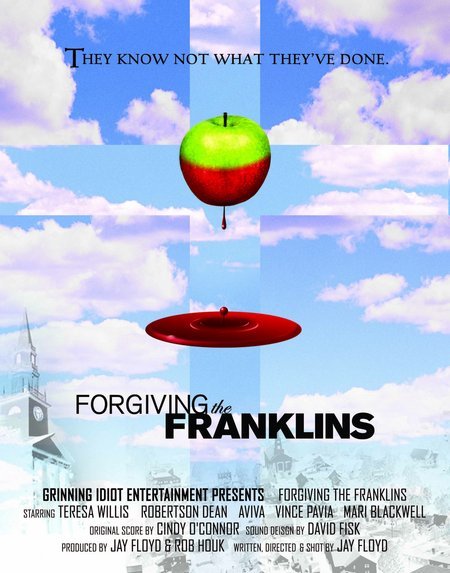
FORGIVING THE FRANKLINS
Budget: $100,000
One of the most striking things about Jay Floyd's feature debut "Forgiving
The Franklins" is the final credit sequence, namely, how few people are in it. It's pretty much Jay, Rob Houk who assisted,
some post folks, and people who helped along the way, like the person who baked the prop apple pie. In other words, this
was pretty much a one-man show--Jay wrote it, directed it, produced it, lit it, shot it, ran production sound, picked out
wardrobe, dressed the set, found locations--you get the picture. This achievement is even more impressive when you recognize
that the film that comes before the end credits doesn't carry any of the hallmarks of a typical no-budget, one-man crew type
of movie. This is a testament to Jay's skill in all the various departments (he's worked professionally in just about every
area of filmmaking over the years) and to the emergence of high-quality, low cost tools like the Canon XL2 camera he bought
to shoot the film. (The XL2 is the standard definition, 16:9, 24p camera that is being eclipsed now by the new HDV line of
Canon cameras).
Comprising numerous locations in both North Carolina and Los Angeles, "Forgiving the Franklins" was shot in 20 days over
a 3 1/2 month period. Floyd used 40% of his $100,000 budget to buy equipment: camera, editing system (FCP), Mini Mole light
kit, microphones (two Sennheiser wireless mic systems and an Audio Technica omni-directional and Audio Technica shotgun mic,
which were connected directly to the camera), a Hollywood Lite vest-supported camera stabilizer, and other assorted items).
Another 30% of the budget covered location rental (some impressive Victorian homes in LA; North Carolina locations were borrowed
or stolen), sound design and mix, high-end color correction on D5, and title sequence. The remaining 30% went to actors'
expenses: salary (he worked under the now-defunct SAG Limited Exhibition contract), travel and food. Actors were responsible
for their wardrobe for each day (they were given Polaroids and a breakdown sheet to keep track of continuity) and Jay took
them to thrift stores for most of their clothes (the entire wardrobe for "Franklins" cost $300). Floyd would typically rehearse
the blocking of a scene, light it, place his microphones, (often hiding a wireless lav or his wired omni-directional mic and
mounting his shotgun to the camera), then bring his actors in and shoot the scene, with the first take being the "throw-away
take." An essential piece of equipment when you're running the sound yourself, Floyd notes, is a Y splitter for the mic cable.
With this adapter, he could run one mic into both channels on the Canon and set the channels to different levels to prevent
peaking. Because the shooting days were relatively short--he never went over 12 hours--he would come home and do an assembly
edit of that day's material each night. This might sound like a lot of work for one person, but Floyd prefers the extra effort
to working with a crew that is stained with the idea that you can't make your own movie. He didn't want or need a list of
why he couldn't do it by himself.
The controversial film, which deals with a deeply Christian family's change of faith following a near-fatal car wreck,
was a hit at the 2006 Sundance Film Festival. Most in the audience got its unique blend of simple proscenium shooting style
(a la influence Luis Bunuel) coupled with an outrageous situational humor, that crosses the line more than a few times. Floyd
warns indie filmmakers not to make Hollywood-type stories on a small budget--they'll just turn out bland. To Floyd, studios
are no longer in the business of storytelling, they're in the busy of product-making. All the creativity in Hollywood these
days is spent on the style of a film, not the story. That creates an opportunity for independent filmmakers to provide audiences
something they're not getting from the studios. Floyd set out to make a movie that doesn't assume that the audience is stupid.
NOW
AVAILABLE ON DVD!
(Click the image below for more information:)
"CHALK"
Budget: under $100k
A bona fide crowd favorite at each festival it plays, "Chalk" was one of the first Competition films to sell out at the 2006
LA Film Festival, where I joined a packed house that was in fits. Told in a verite, documentary-like style complete with
interviews (but not a conscious mock-documentary), "Chalk" follows several young high school teachers and a first-year Assistant
Principal during a typically tumultuous school year. Director Mike Akel and Writer/Actor Chris Mass were actual high school
teachers and the film was shot in the Austin school at which they taught, and includes many actual students and teachers.
This verisimilitude, along with some finely tuned comic situations that came from real-life experiences, give the film an
honesty and truthfulness seldom seen in studio-produced school-set films. "Chalk" was shot on a DVX100 in a loose, almost
improvised style that found the action as it occurred. While most of the film was scripted, it has a very natural, improvisational
feel that can be attributed to the filmmakers ability to create situations on the spot, whispering instructions or lines in
characters' ears unbeknownst to the other actors in the scene. Some of the best moments came out of this kind of seat-of-your-pants
creativity. The final budget may have tipped into six-figures, but to me it qualifies as a no-budget film--production started
with just $10,000. While the film missed the Audience and Target Filmmaker Awards at the 2006 LA Film Festival, it did snag
an Outstanding Performance Award for the ensemble cast. And the recent Austin Film Festival turned out to be a gold mine for
the film, where it snagged both the Grand Jury Prize and the Audience Award. This must have caught the eye of the Spirit Award
Nominating Committee--the film has just been nominated for the Cassavetes Award. The filmmakers can add these prizes to their
already-crowded mantle, which includes the Grand Jury Award from the Independent Film Festival of Boston, the Audience Award
from Cinequest, and another Special Jury Award for Acting from the Florida Film Festival. The film opened theatrically in
the Summer of 2007 through Morgan Spurlock's new label, Morgan Spurlock Presents. It is now available on DVD.
VIEW THE TRAILER BELOW:
NOW
AVAILABLE ON DVD!
(Click the image below for more information:)
"HEAD TRAUMA"
Budget: $125k
Director Lance Weiler, co-director of the amazing "The Last Broadcast", took his time with the follow-up and it shows. After 3 1/2 years of work, which included 90 days of shooting in over a
year's time, Weiler World Premiered "Trauma" in the 2006 LAFF's Dark Wave section, which was an appropriate venue for the
creepy, often frightening, psychological thriller. Weiler shot over 220 hours of footage on a Panasonic DVX100, constantly
asking himself how he could make the film better and not being afraid to chuck things that didn't work and reshoot. Because
he could do so economically, he wrote a lot of the script with the camera, improvising on the spot and changing his plan
often. The project developed therefore in a very organic way and Weiler was extremely pleased with the process. This kind
of filmmaking represents one of the big advantages of a no-budget production technique. While there were days where the crew
was as large as 15-20 people, some days there were just Weiler and his lead actor. They finished editing on FCP in the middle
of last year, but spent several months working on the music and sound. Through connections, Weiler was able to do a 5-day
mix at Skywalker sound. Color correction was done in a 4:1:1 color space on FCP because it would have been too expensive
to redigitize the material. They bumped to HD for the LAFF straight from their hard drive. In all, it cost him $70k to
put the film in the can and to date, Weiler has spent $126,000 total, which has gotten him all the way to an HD master, a
final DVD, and all the materials he needed to deliver for domestic distribution. The money was well-spent--the film is impressively
put together with high production values in all departments.
Weiler used his LAFF premiere the way a studio would use
it--as a launching pad for his own self-distribution. His experience with self-releasing "Broadcast" gave him the knowledge
to do the theatrical himself. The film played in 17 cities across the country. The venues were all independently-owned and
are capable of video projection (there was no film print of "Trauma"). None of the venues were four-walled; Weiler negotiated
a box office split with each theater. He was with the film for at least one night in every city, doing interviews for newspapers
and radio, and selling merchandise all along the way. The DVD was released through Heritage Films and Weiler managed to negotiate
incredible terms, including the right to sell the DVD himself off his own website. Like many enlightened filmmakers, Weiler
thinks conventional distribution is broken and is intimately familiar with the kinds of bad deals filmmakers make with distributors.
He believes in the power of filmmakers to be able to greenlight and distribute their own works. To help with the distribution
part, Weiler has launched a number of exciting initiatives: an incredible web resource for DIY media-makers, (The Workbook Project), a film festival, (From Here To Awesome), a traveling speaking series, (DIY Days), and numerous articles he has written for Filmmaker, MovieMaker, and the like. The DVD for "Head Trauma"
also has many helpful extras.
NOW
PLAYING IN THEATERS!
(Click the image below for more information:)
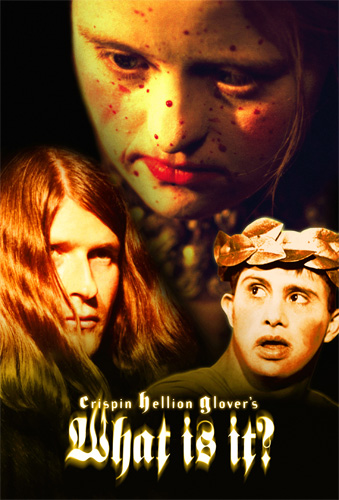
"WHAT IS IT?"
Budget: $150k
Crispin Hellion Glover's aptly titled "What Is It?" isn't exactly a no-budget film--it was finished to 35mm for between $150,000
and $200,000--but it certainly qualifies as an authentic DIY (do-it-yourself) production--it was just made by someone who
had some money to spend on their film. And it's a good thing that Glover was willing to invest in his own movie, because
"What Is It?" is not the kind of movie that corporate Hollywood, (or anyone else worried about getting a return on their money)
would ever invest in. And that is really Glover's point.
So, yes, most of you know Crispin Glover (he uses his middle name when he's the creator of a work) as the enigmatic actor
who played McFly in "Back To The Future," and more recently had parts in "The People Vs. Larry Flint" and the "Charlie's Angels"
flicks. He has a tradition of playing strange characters and a reputation for being pretty strange himself. "What Is It?"
will certainly not tarnish this reputation. Premiering in the Frontier section of the 2005 Sundance Film Festival, the film
is correctly categorized as "experimental" or "avant-garde," but more so, it is a tour de force in strangeness, and most importantly,
uniqueness. It's a film less about narrative and character development, and more about ideas. And while Glover isn't interested
in telling you what it all means, (just like most serious artists), he is interested in discussing the experience of watching
it, and how it makes you feel. The film is an exploration of taboo, in an era where corporate-controlled media companies
have excised any objectionable material out of their programming. Glover is asking what is taboo, what does it mean that we
can't process a taboo. As an audience, we're constantly asking ourselves, "is this right?"--is it right that I'm watching
this, is it right that he made it?
The film has an interesting production history that dates back to 1995. Glover shot what was intended to be a short film
promoting the concept of working with actors with Down's Syndrome. He shot for 4 days on 16mm and edited for 6 months. He
realized that his 85 minute short had taken on a new life, so over the next 2 1/2 years he shot another 8 days here and there
between acting gigs, adding an antagonist--played by himself--and another character played by screenwriter Steven Stewart,
to go along with his mostly Down's Syndrome cast. After 4 years he locked picture, interestingly enough, using a very early
version of Adobe Premiere, making it one of the first features edited in this way. He paid dearly in headaches and cost overruns
for riding the bleeding edge. He then spent years working on the sound design himself and trying to figure out a way to do
all the expensive film opticals cheaply. Ultimately, technology caught up with him and he was eventually able to do them
digitally, utilizing a DI process and transferring to 35mm for his Sundance premiere. The film is part of a trilogy and Glover's
second movement, "It is Fine. Everything Is Fine!" just got into the upcoming Sundance Film Festival. That script was written
by Stewart, who suffered from cerebral palsy and died in 2001.
Glover has been touring with the show around the country to sold-out audiences. The evening features a screening of the film,
a discussion afterwards by Glover, and a unique dramatic reading of excepts from Glover's books with an accompanying slide
show. Glover has been doing the book-reading thing since 1992 and it has become very popular. The film is an excellent complement
to the slide show and you will definitely want to ask questions after a screening of this film.
And it is a hoot--at once violent, sweet, pornographic, crude and always endlessly provocative. While most experimental films,
to me anyway, become boring, "What It Is?" is continually fascinating and often hilarious. It's an exploitation film made
by a filmmaker who's exploiting our perception of what exploitation is. More importantly, it's a lesson in thinking creatively
out-of-the-box. I stress the importance of uniqueness in my classes and I've said that uniqueness trumps talent. As aspiring
no-budget filmmakers we can't all be talented, but there's no excuse for us to be derivative. No-budget filmmaking gives
us the opportunity to create unique works, which are what programmers at major festivals like Sundance and critics are looking
for. "What Is It?" is an inspiration in this regard. It's a lesson plan for pushing away the walls that confine our ideas.
VIEW THE TRAILER BELOW:
NOW
AVAILABLE ON DVD!
(Click the image below for more information:)
"MUTUAL APPRECIATION"
Budget: $50,000
From Andrew Bujalski, the director of the underground, indie hit "Funny Ha Ha" comes the new film, "Mutual Appreciation." "But wait, I haven't heard of either of these films," you say! Well, you better
get out and buy the first (available on DVD from Wellspring) and go see the second, which is opening across the country as part of IndieWire's Undiscovered Gems Series. And a gem it is. A throwback to the low-budget indie film halcyon days of the early '90's, the film was shot on B&W
Regular 16mm. It says a lot about where indie cinema has gone since then to realize that neither "Funny Ha Ha" or "Mutual
Appreciation" ever made it into Sundance. "Mutual" is the kind of film that would have been a hit at Sundance in 1993, and
Bujalski would be a name as common as Jarmusch or Hartley to indie film audiences. To critics, who have consistently compared
the 28 year old to John Cassavetes, the name is well-known. Working in a simple style and with a tiny crew, Bujalski is left
to concentrate on one thing--the performances. And the words, which seem to emanate and stumble out of the character's mouths,
rather than get put to page, memorized, and then "performed." The cast here is in fine form, including the director himself,
who was such a revelation in "Funny Ha Ha." Also back in a smaller part is "Funny Ha Ha" lead Kate Dollenmayer. But the stars
of "Mutual", besides Bujalski, are Justine Rice and Rachel Clift. The three form a certain kind of threesome, nearly sexual,
but not quite, the way old friends who have often wondered what it would be like to kiss each other form a bond. Not that
there's anything kinky going on here, I'm telling you there's not. This film's edge is its lack of edge, its throwback style,
its utter honesty.
Certainly this style evokes that of the man known as the "father of independent cinema"--a raw,
artless look, 16mm grain, naturalistic, improvised performances. But it doesn't give Bujalski his due to make the easy comparison.
If it helps to get people into the theater, and sets up the proper expectations for his work, then great--he will certainly
need that. Because the one trait that Bujalski most significantly shares with Cassavetes is his uncompromising search for
the truth. The truth he is after, and where he chooses to find it are very different, but in a day and age where cinema, certainly
U.S. cinema, has lost its desire both to be uncompromising and to search for truth, Bujalski's work is like a breath of fresh
air. His films are deceptively engaging. His narratives, if you can call them that, sneak up on you. Just when you think that
nothing is happening, you look back and realize you've been on a journey, a journey hidden by all the normal, natural things
people do when they talk. And that's what people do in Bujalski's movies, they talk. They talk like you and me, or they probably
don't, but they seem familiar, comfortable, and real--no one "flubs a line" in these movies, they stammer. In "Mutual Appreciation,"
they also sing, and very well. Justine Rice is actually the lead singer of the successful band Bishop Allen. But the film
is mostly a series of interior-shot scenes of people talking, being themselves, and slowly, cumulatively, the film creates
a certain truth. In the case of "Mutual," it's the truth about friendships, and relationships. Nothing too dramatic or melodramatic,
but ultimately honest in a way that Hollywood has long forgotten how (or maybe never really has been able) to do.
VIEW THE TRAILER BELOW:
NOW
AVAILABLE ON DVD!
(Click the image below for more information:)
"The Puffy Chair"
Budget: $15,000
The Duplass Brothers, Jay and Mark, shot this in a few weeks with a 3-man crew
on a Panasonic DVX-100. Jay shot it and Mark plays the lead, alongside his girlfriend, who plays his girlfriend in the
movie. The brothers' parents also appear (as parents) and financed the film, making it a truly homemade, family affair.
Much of the film's hilariously droll dialogue was improvised, as was the camerawork used to capture the action. "Puffy"
premiered at the 2005 Sundance Film Festival and was later nominated for two Spirit Awards. Roadside Attractions and
Netflix picked up the film for distribution, and it played theatrically across the country, and it is now available on DVD
through Netflix. With the success of "Puffy," the Brothers Duplass scored a deal with Universal Studios, but that didn't stop
them from making no-budget films, (See "Humpday" above)--creative control and artistic freedom are hard to give up.
VIEW THE TRAILER BELOW:
NOW
AVAILABLE ON DVD!
(Click the image below for more information:)
"Room"
Budget: Under $100k
University of Texas alum Kyle Henry's feature debut, "Room" premiered at the
2005 Sundance Film Festival and then played in Cannes. Shot with the DVX-100 in Austin, Houston, and New York by P.J.
Ravel (who shot recent LAFF Jury Prize Winner "Gretchen"), "Room" was nominated for two Spirit Awards and played in selected
theaters in 2006 as part of IndieWIRE's Undiscovered Gems Series. It's now available for rental through Netflix.
NOW
AVAILABLE ON DVD!
(Click the image below for more information:)
"Cavite"
Budget: 2 expensive plane tickets
A classic no-budgeter (the reported budget was "two expensive plane tickets")
shot with a two man crew: the Co-Director/Camera Operator/Co-Editor/Co-Writer Neill dela Llana, and the Co-Director/Co-Editor/Co-Writer/Sound
Mixer/Lead Actor Ian Gamazon. That's right, one guy shot the movie and the other guy starred in it (and ran the sound).
The title refers to Cavite City, a city outside of Manila, Philippines. The majority of the film takes place in a series
of slums in this area of the country and it is eye-opening. To my knowledge, this part of the world hasn't really been
captured in a feature film before. Without giving too much away (you should see it!), the story is a kind of political
thriller, very timely and very provocative. Many ideas I stress in my classes are in evidence here. Read their
Production Notes (http://www.cavitemovie.com/production_notes.html) and see just how they Embraced Their Limitations. They also chose to
own their equipment, buying a Panasonic DVX100 24p camera with a credit card to shoot the film and then selling it to purchase
their editing system to edit it. Cavite premiered at Rotterdam and SXSW and won a Spirit Award. It
was released theatrically through Marc Cuban's Truly Indie and is now available on DVD.
NOW
AVAILABLE ON DVD!
(Click the image below for more information:)
"SLEEPING DOGS LIE" (formerly "Stay")
Budget: Under $100k
This hilarious comedy directed by comedian/filmmaker Bobcat Goldthwait
was a hit when it premiered at the 2006 Sundance Film Festival, (under the title "Stay"). Roadside Attractions and Samuel
Goldwyn snatched it up fast--just don't get it confused with Roadside's other Summer movie, "Lassie;" this is not for the
kids! Film was put in the can and made it to Sundance for under $100k. Shot on a borrowed Panasonic Varicam by
a DP Producer Marty Pasetta, Jr. (a speaker in No Budget Film School's May 6, 2006 class) found on Craigslist, the idea was
conceived, script written, and shooting begun in a 6 week period. It opened theatrically across the country in October
2006.
VIEW THE TRAILER BELOW:
NOW
AVAILABLE ON DVD!
(Click the image below to view trailer:)
"The Conventioneers"
Budget: way below $100k
Made for nearly nothing and shot on Panasonic DVX100 miniDV cameras, Conventioneers
is a clever romantic drama that follows two former Princeton classmates, one a married delegate attending the 2004 Republican
National Convention in New York City and the other a lefty Democrat planning a big protest during the convention. Shot
against the backdrop of the actual convention--and in many cases, right smack in the middle of it--the film captures the energy
and authenticity of politics and an illicit love affair in a way that much bigger films usually miss. This is all the
more remarkable when you consider how the film came together.
Conventioneers was Director Mora Stephen's
NYC graduate film school thesis project, and they were able to get a bunch of free stuff from NYU, including insurance, most
of their grip and electric (which wasn't much--it had to all fit in their two cars), DAT machine, mics, 35mm lenses for their
P + S Technik adapter, and most of their student crew. The P + S and the G&E were used in their single-camera scenes,
like those set in hotel rooms and apartments. Much of the film, however, was shot out in the streets on multiple cameras,
sometimes as many as six at a time. The many cameras amounted to 87 hours of footage captured on several different
kinds of formats. Most of their locations were borrowed or stolen, though they paid for the hotel room and the right
to shoot all over the hotel. The Tribeca Film Festival, where Conventioneers had its world premiere, helped them
procure the Embassy Suites for a reasonable sum. Their biggest expense was food (which is typical for a micro-budget
project). They used a SAG Student Film contract, though their leads were not SAG. Shot in four weeks (2 1/2 weeks
with the actors) on a loose schedule with never more than a 7-man crew, producer/editor/co-writer Joel Viertel found himself
shooting, gaffing, and booming much of the movie. He edited with Final Cut Pro 4 on a Mac G4 utilizing two LaCie 250GB
drives. Color correction was done in FCP and for Tribeca, a DVCAM master was upconverted to HDCAM for digital projection.
Motivated by the time limitation of the upcoming convention, the film was financed on credit cards and a locked picture came a
week and a half before their Tribeca premiere. Think that's harrowing, the crew was also arrested during one of the
protests and their equipment was confiscated as evidence. What some people have to go through for their art!
Conventioneers
won the coveted John Cassavetes Award at the Spirit Awards. The film opened theatrically in 2006 and is now available
on DVD. A perfect film to see before any presidential election!
VIEW THE TRAILER BELOW:
NOW
AVAILABLE ON DVD!
(Click the image below for more information:)
"In Between Days"
Budget: $60,000
Winner of a special jury prize at the 2006 Sundance Film Festival and the FIPRESCI
Prize at the 2006 Berlin Film Festival, director So Yong Kim's beautiful feature was shot with the DVX-100 with a four-man
crew. Working with her husband, producer Brad Rust Gray, the duo followed their first feature "Salt" with this festival
favorite.
NOW
AVAILABLE ON DVD!
(Click the image below for more information:)
"The Talent Given Us"
Budget: $30,000
Andrew Wagner's dysfunctional family comedy stars his own family, playing themselves!
Shot with a two-man crew on the DVX-100, "Talent" premiered at the 2004 Cinevegas Film Festival where it won the Grand Jury
Prize. It was subsequently invited to the 2005 Sundance Film Festival and was released theatrically later
that year by Vitagraph Films.
NOW
AVAILABLE ON DVD!
(Click the image below for more information:)
"DEAR PILLOW"
Budget: $3,800
Director Brian Poyser knew from his experience working at the SXSW Film
Festival what festivals wanted to program. He used this knowledge, and some truths from deep in his soul, to concoct
the story of a porn-obsessed, awkward 17 year old who befriends an aging homosexual who lives in his complex and writes
tales for a Penthouse Forum-like magazine (called Dear Pillow, or course). The unlikely pair are joined by the
beautiful landlady of the complex in a very odd love triangle, of sorts. Though not gratuitous visually, the frank and
honest dialogue might scare off the timid viewers of say, The Lifetime Network, but is perfect for the more adventurous film
festival crowd. Put in the can for just $3800, which came from two film grants, and shot on a borrowed DVX100, Poyser
and producer/editor/DP Jacob Vaughan (a guest speaker in No Budget Film School's Houston class) have fashioned a brutally
honest, at times hilarious, alternative to studio coming-of-age films. "Pillow" was shot with a 4-5 man crew in 23 days
over a month and the budget broke down as follows: $1000 to rent two apartments that were used as the main sets; $1000
for set dressing (they rented furniture from thrift stores for 20% of full value and returned it after the shoot); $1000 for
meals and craft service; and $800 for miscellaneous. They borrowed grip and electric equipment (nothing more than would fit
in a Toyota 4-Runner) from the Duplass Brothers in exchange for a co-production credit. Shot with one of the first DVX-100's
in 24p Advanced mode and edited on FCP, the film was color-corrected in FCP and mastered on DVCAM; a Digibeta dub was used
for festival screenings. "Pillow" premiered at the 2004 Slamdance and played over 30 festivals before being nominated
for the prestigious Someone To Watch Award. The success of "Pillow" allowed the duo to make "The Cassidy Kids", a $600k
film for Burnt Orange Productions, "Cassidy Kids." "Pillow" is now finally available on DVD through Heretic Films.
VIEW THE "MAKING OF" VIDEO BELOW:
AVAILABLE
ON DVD!
(Click the image below to purchase:)
"Following"
Budget: $12,000
Before "Batman Begins"; before "Insomnia"; before "Memento", there was
"Following", Chris Nolan's no-budget gem. Shot on Saturdays for a year on 16mm B&W, Nolan put "Following" in the
can (the old-fashioned way, on film) for $6,000 and finished it to 16mm for festivals for a total of $12,000. Following
its unassuming premiere at the San Francisco Int'l. Film Festival (which at that time was programmed by current LAFF
head of programming Rachel Rosen), my former company Next Wave Films gave Nolan finishing funds to blow it up to 35mm and
remix the sound. It next played Toronto, where it was a huge success, garnering domestic theaterical distribution (Zeitgeist
Films) and selling overseas in several territories. Then came Rotterdam, where it won the top prize, the Tiger Award, and
then many more festivals and prizes followed. The success of "Following" allowed Nolan to make "Memento" for $5 million,
and the rest is history. There would be no sequel to "Batman Begins" if it weren't for the little film that Chris wrote,
shot, directed and edited himself, and the help he received from a dedicated band of talented, unknown actors who rehearsed
for 6 months before a single frame was shot; and a producer who later became his wife. "Following" represents no-budget
filmmaking at its best--working with available resources, embracing your limitations, and reinventing the movie-making process
to fit your unique circumstances.